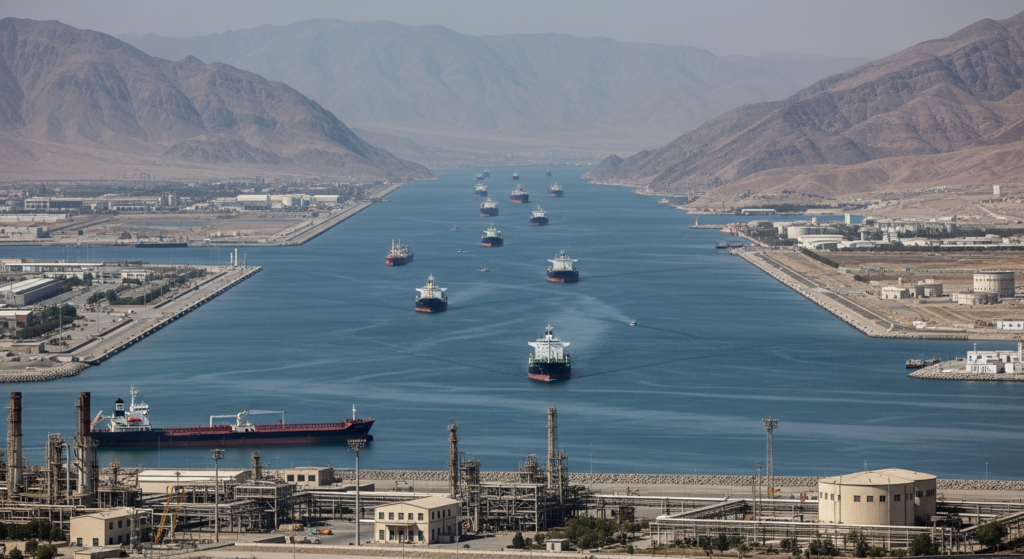
The United States has conducted strikes on targets in Iran, according to non-federal international and U.S. reporting, in response to a series of attacks on commercial shipping near the critical Strait of Hormuz. These military actions coincide with the implementation of new sanctions targeting Iran’s oil sector, developments that collectively heighten the risk profile for global maritime trade and energy markets.
The Strait of Hormuz, a narrow chokepoint between the Persian Gulf and the Gulf of Oman, is one of the world’s most vital maritime passages, through which a significant portion of the world’s seaborne oil supply transits daily. Disruptions or increased security concerns in this region can have immediate and far-reaching effects on global energy prices and supply chains. The recent ship attacks and subsequent U.S. response have underscored the fragility of this critical artery for international commerce.
Further complicating the situation are the new oil-related sanctions imposed on Iran. These measures aim to restrict Iran’s ability to export oil, potentially reducing global supply and contributing to upward pressure on crude oil prices. The combined effect of military tensions and economic sanctions creates an environment of elevated shipping risk, leading to higher insurance premiums for vessels operating in the region and potentially longer transit times as shipping companies reroute or take additional precautions.
While the primary events unfold thousands of miles away, the interconnected nature of the global economy means that such geopolitical developments can have tangible, albeit indirect, effects on communities like Greenville. Local observers are monitoring the situation for potential impacts on various sectors.
One immediate area of concern is fuel prices. Any sustained increase in the cost of crude oil on international markets typically translates to higher prices at the pump for consumers and businesses in Greenville. This can affect household budgets, transportation costs for goods, and operational expenses for industries reliant on fuel.
Beyond direct fuel costs, the heightened shipping risk and potential disruptions to global supply chains could affect logistics and freight operations. Companies that import or export goods through major U.S. ports, which then rely on overland transport to reach distribution hubs and manufacturing facilities in the Upstate region, may face delays or increased costs. This includes a wide array of businesses, from retail to manufacturing, that depend on the timely and cost-effective movement of materials and finished products.
The situation also holds potential relevance for military families residing in or near Greenville. As geopolitical tensions escalate, families with members serving in the armed forces may experience increased uncertainty regarding deployments or operational readiness. While specific details are not available, the broader context of U.S. military engagement in the Middle East is a factor for those with direct ties to the defense community.
Local officials and economic development agencies in Greenville are likely to be tracking these international developments, understanding that global events can ripple through the local economy.
### Why it matters in Greenville
The unfolding geopolitical situation, marked by U.S. strikes and new oil sanctions, carries potential economic implications for Greenville, particularly concerning the region’s robust manufacturing and logistics sectors. Major employers like BMW Manufacturing Co. and Michelin North America, both with significant operations in Greenville County, rely heavily on stable global supply chains and predictable transportation costs. Disruptions in international shipping lanes or sustained increases in fuel prices could translate into higher operational expenses, potentially affecting production schedules or consumer prices for goods. Furthermore, the broader economic ripple effects, such as increased costs for daily commutes or the transport of essential goods, could be felt by households and small businesses across Greenville, underscoring the interconnectedness of global events and local economic stability.