Editor’s Disclosure
HEREGreenville.com is published by HERECity Network, an independent local news organization. Your Indoor Golf Solutions, the subject of this article, has a business relationship with HERECity Network as a technology and services partner. This article was reported, written, and edited by a HERE editor to HERECity Network’s editorial standards. Your Indoor Golf Solutions reviewed the article for factual accuracy regarding its own business operations only; editorial judgment and final publication decisions rest with HERECity Network. See our Editorial Standards.
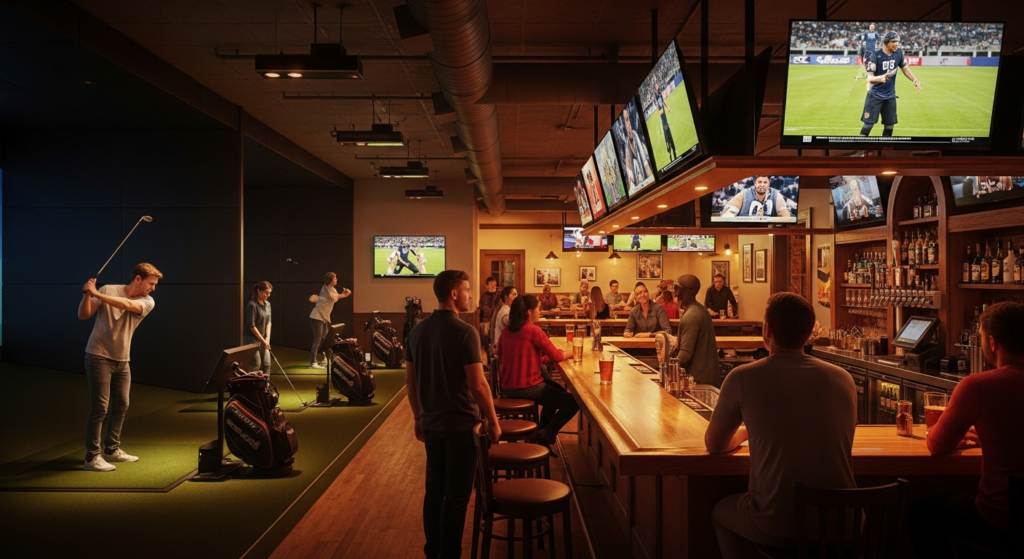
Walk into one of the newer bars near downtown Greenville on a Tuesday night and you might find the busiest corner of the room isn’t the bar itself — it’s a golf bay, with four people rotating through swings between rounds of beer and wings. That combination, once a novelty, is now a business model with its own name: eatertainment.
The formula has real economics behind it. National operators X-Golf and Five Iron Golf built entire chains around pairing simulator bays with full food and beverage programs, and the results show up on their income statements: 30% to 40% of total revenue at both companies comes from food and beverage, with alcohol sales particularly profitable, according to RG Golf’s 2026 industry analysis. Five Iron Golf’s average location generates roughly $1.83 million a year; X-Golf averages closer to $414,000 per unit — a gap that reflects format and footprint more than the underlying appeal of the concept.
For Greenville bar and restaurant owners eyeing a similar build-out, the appeal isn’t just the novelty factor — it’s a second, largely weather-proof revenue stream layered onto a business that already knows how to run a kitchen and a bar.
Why bays and bars pair so well
A golf bay doesn’t compete with a bar’s core business; it extends it. Groups that come in for a simulator session tend to stay longer and order more than a typical bar tab, because the activity itself creates dwell time — the same dynamic that made shuffleboard and darts profitable additions in an earlier era, just with far higher per-hour revenue potential.
Golf O’Clock’s dataset of 200-plus simulator venues estimates a single bay running at 60% utilization and a $50 hourly rate can produce $4,000 to $5,500 a month in simulator revenue alone, climbing to $6,000 to $8,000 once food and beverage attach. For an existing restaurant or bar, that’s incremental revenue built on infrastructure — kitchen, staff, liquor license — that’s already in place.
The payback timeline that gets owners’ attention
What separates a golf bay from most capital improvements a bar owner might consider is speed of payback. Golf Sim Masters puts the typical payback period for a bar-attached bay at 3 to 8 months once the F&B uplift is factored in — a dramatically faster return than most renovation or expansion projects in food service.
That timeline assumes the install is sized and configured correctly for the space and the crowd it’s serving, which is where a lot of first-time operators either overspend on commercial-grade gear they don’t need or underspend on a launch monitor that can’t hold up to nightly bar traffic.
Getting the build right the first time
The eatertainment model works because the golf and the hospitality sides are both done well — a bay bolted onto a bar with no thought given to sightlines, noise, or staff workflow won’t perform like the ones driving X-Golf and Five Iron’s numbers. Space planning, technology tier, and F&B integration all need to be solved together, not sequentially.
That’s a scoping problem a bar owner in Greenville generally hasn’t solved before, and it’s exactly the kind of project a dedicated simulator consultant is built to walk through before any construction begins.
What the buildout actually costs
RG Golf’s 2026 analysis estimates an all-in single-bay build — equipment, buildout, FF&E, and soft costs — at $50,000 to $150,000, while a small 2-to-3-bay lounge concept can run $55,000 to $230,000, according to Attractions Marketing Pros. Equipment financing can reduce the upfront capital requirement by 40% to 50%, per the same source — a detail that often determines whether an existing Greenville bar owner adds one bay this year or waits another season.
Those figures sit alongside a broader industry expansion: commercial simulator venues nationally have nearly tripled since 2022 to more than 1,500 locations, according to the National Golf Foundation, and well-run operations are posting 15% to 25% profit margins at $500,000 to $900,000 in revenue for a six-bay facility, per Attractions Marketing Pros. The category has grown well past the experimental phase.
Local Sports Lens
Your Indoor Golf Solutions, PGA Pro-owned by Greg Sheffield, has spent 25 years installing indoor golf simulators for homes, businesses, restaurants, and bars. The company works with clients nationwide — including South Carolina — and provides consulting on which technology tier, space configuration, and F&B integration makes sense for a given venue. Businesses considering a simulator install can request a consultation at (309) 826-0439 or via the HERE partner page.
The bays filling up on a Tuesday night in Greenville aren’t an accident of timing. They’re the result of operators who did the math before they built.