

News Summary
As housing prices soar in Greenville, many homebuyers are seeking more affordable options in surrounding areas. Trends show an increase in interest in suburbs and rural locations, where housing prices are significantly lower. The spike in median home prices, driven by cash-rich buyers post-pandemic, has led buyers to consider different types of properties, including mini-farms. Despite challenges such as rising interest rates and tariffs on building materials, the demand in Spartanburg County remains strong due to lower land costs and less restrictive regulations.
Greenville – As housing prices continue to rise in the Greenville area, more homebuyers are expanding their search beyond city limits in search of affordable options. Recent trends indicate that prospective buyers are increasingly looking in surrounding areas, including Piedmont, Pendleton, Boiling Springs, Woodruff, Laurens, and Union counties. This shift in focus comes as buyers are willing to accept longer commute times to secure more affordable homes.
In June 2025, the median price of sold homes in the Greenville area reached a record $330,000. The increase is largely attributed to a post-pandemic influx of cash-rich buyers, which has intensified competition and driven prices upward. As affordability becomes a growing concern, many buyers are exploring suburban and more rural areas where properties can be found at significantly lower prices.
The construction of Pinebrook, a new home community developed by DRB Homes in Spartanburg County, highlights this trend. The starting price for residences in this community is $422,990. In addition to Pinebrook, there are other developments in the region. Century Complete is developing Buffalo Creek in Union with prices starting at $217,888, while Meritage Homes is launching The Farm at Wells Creek in Gray Court, starting at $291,900. Furthermore, Lennar is introducing Springdale Towns in Clinton, with prices beginning at $204,999.
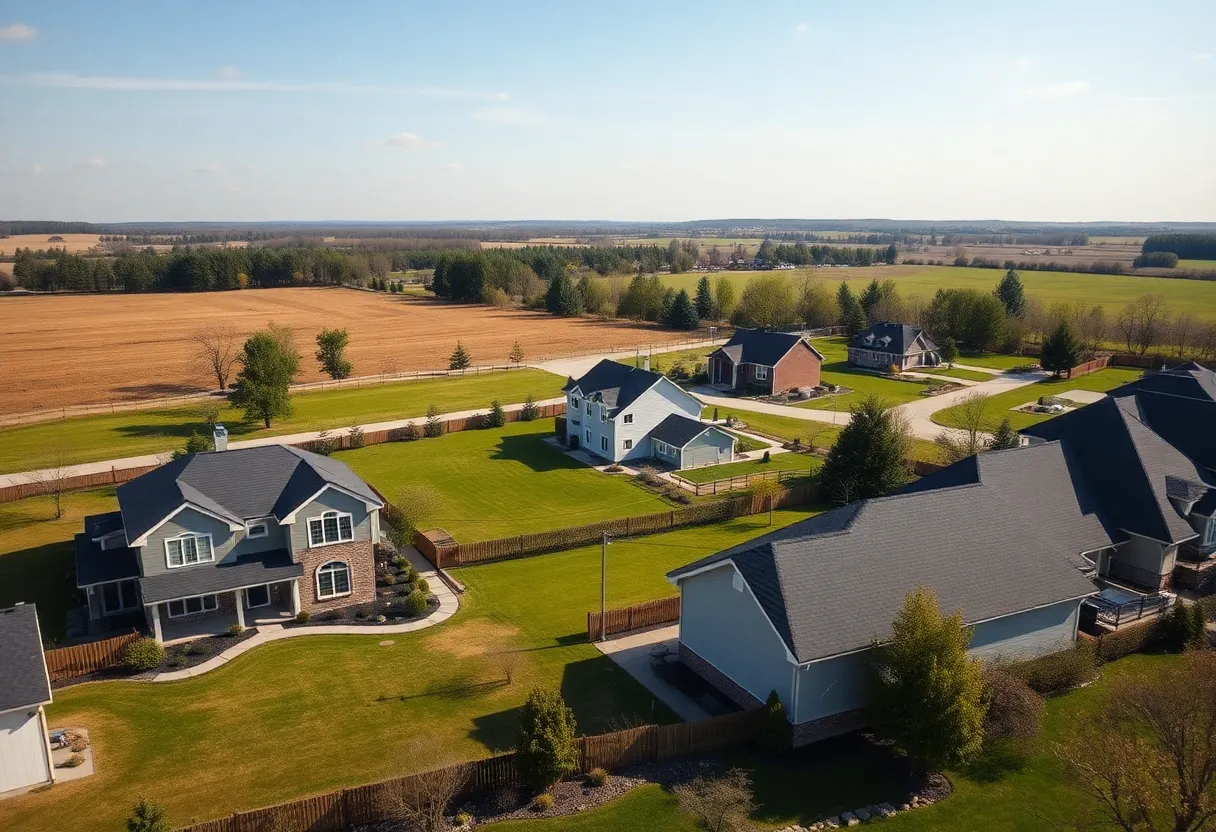
As buyers search for more affordable housing, they are not only re-evaluating locations but also considering different types of properties. An increase in the development of “mini-farms,” which consist of parcels with 3-5 acres, has been observed in more rural areas. This trend caters to homebuyers seeking larger spaces but also requires them to adapt to the increased maintenance associated with larger lots.
While affordability remains an issue, it is also compounded by external factors affecting the housing market. Year-over-year new home sales have seen a dip of 2.6% largely due to rising interest rates, which currently range between 6.5% to 7%. Potential buyers labeled as “mortgage locked” face challenges securing rates, impacting their ability to afford homes. Additionally, rising tariffs on materials like copper and lumber threaten to increase costs for homebuilders, adding further uncertainty to the market. For instance, the lumber budget for a $500,000 house can total around $180,000, and this cost could escalate by an additional $63,000 if tariffs on Canadian lumber are imposed.
Despite these challenges, Spartanburg County has been recognized as a pro-growth region that continues to attract builders, particularly in towns like Woodruff and Boiling Springs. The prevailing economic conditions have also led to a notable shift in land pricing, with the cost of land in more outlying areas ranging between $25,000 to $50,000 an acre, significantly lower than the $100,000 per acre seen closer to Greenville. Additionally, regulations in distant counties tend to be less restrictive, making them attractive options for developers and buyers alike.
The ongoing uncertainty in the housing market, driven by fluctuating material costs and interest rates, suggests that homebuyers in the Greenville area will likely continue expanding their search for affordable housing options in the coming years. As buyers adapt to these market dynamics, the landscape of homebuying in and around Greenville is poised for transformation.
Deeper Dive: News & Info About This Topic
HERE Resources
Raleigh Named Best-Performing Large City in the U.S.
Eviction Crisis Deepens in Greenville County
Greenville Welcomes New Affordable Senior Housing Development
Eviction Crisis in Greenville and Charleston
Housing Affordability and Mixed-Use Development in Greenville: Balancing Growth and Equity
Greenville Plans Open-Air Rooftop Cinema as Part of Redevelopment
Historic Greenville Home Sells for $2.95 Million
South Carolina Surpasses Texas as Fastest-Growing State
Soby’s New South Cuisine Becomes First in SC to Win Grand Award
Greenville Racial Equity and Economic Mobility Commission to End Operations
Additional Resources
- Post and Courier: Greenville Affordable Homes
- Realtor.com: Top 10 Cities for New Construction Homes
- Go Upstate: Housing Boom in Spartanburg County
- Charlotte Observer: Business News
- Upstate Business Journal: Spartanburg Stadium Development
- Wikipedia: Real Estate
- Google Search: Affordable Housing Greenville
- Google Scholar: Housing Market Trends
- Encyclopedia Britannica: Housing
- Google News: Greenville Real Estate